Surrogate Mother Experiment
Harry Harlow & the Science of Love
Harry Harlow was one of the first psychologists to dive into the tricky subject of human love and affection. Through his now-famous and controversial monkey experiments, Harlow shed light on just how important early bonds, affection, and emotional connections are for healthy development.
Back in the 1950s and '60s, most psychologists were either behaviorists or psychoanalysts. They believed that babies became attached to their mothers primarily because of food. Harlow, along with some social and cognitive psychologists, disagreed. He argued that comfort, companionship, and love were just as critical for a child’s growth.
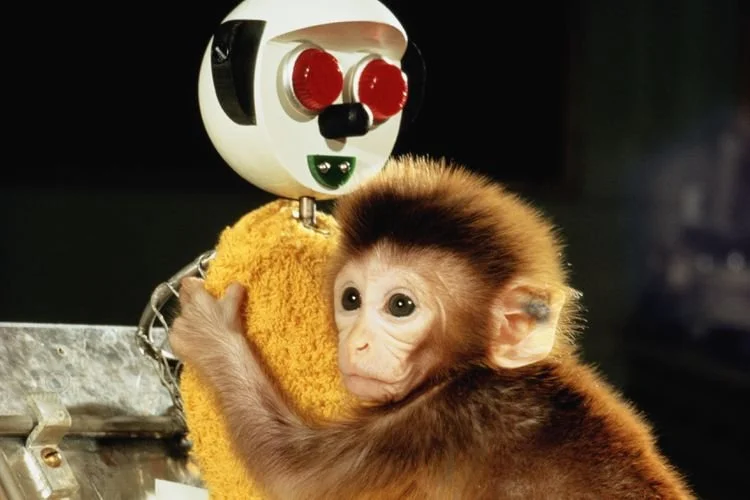
To prove his point, Harlow conducted a series of experiments with baby rhesus monkeys, observing how early separation from their biological mothers impacted their behavior later in life. He separated the infant monkeys just hours after birth and introduced them to two inanimate "surrogate" mothers—one made of wire mesh and the other covered in soft cloth. The wire mother wasn’t cozy but could provide food, while the cloth mother was soft and cuddly.
In the first part of the experiment, the baby monkeys had both surrogates to choose from, and both provided nourishment. In the second part, they were divided into two groups—some were raised only by the wire mother, and others by the cloth mother, without any choice.
What Harlow discovered was fascinating. The baby monkeys overwhelmingly preferred the soft, cuddly cloth mother, even though both surrogates provided food. When faced with scary or unfamiliar situations, the monkeys would run to the cloth mother for comfort, then feel secure enough to explore. But without a mother figure, they were paralyzed with fear and huddled up, sucking their thumbs. In another scenario, when an alarming toy was introduced, the monkeys with a cloth mother felt brave enough to check it out. Those without a mother just cowered in fear.
Now considered a “classic” in behavioral science, this Monkey experiment ultimately reinforced the importance of mother-and-child bonding. More than 70 years later, Harlow’s discoveries continue to inform the scientific understanding of the fundamental building blocks of human behavior.