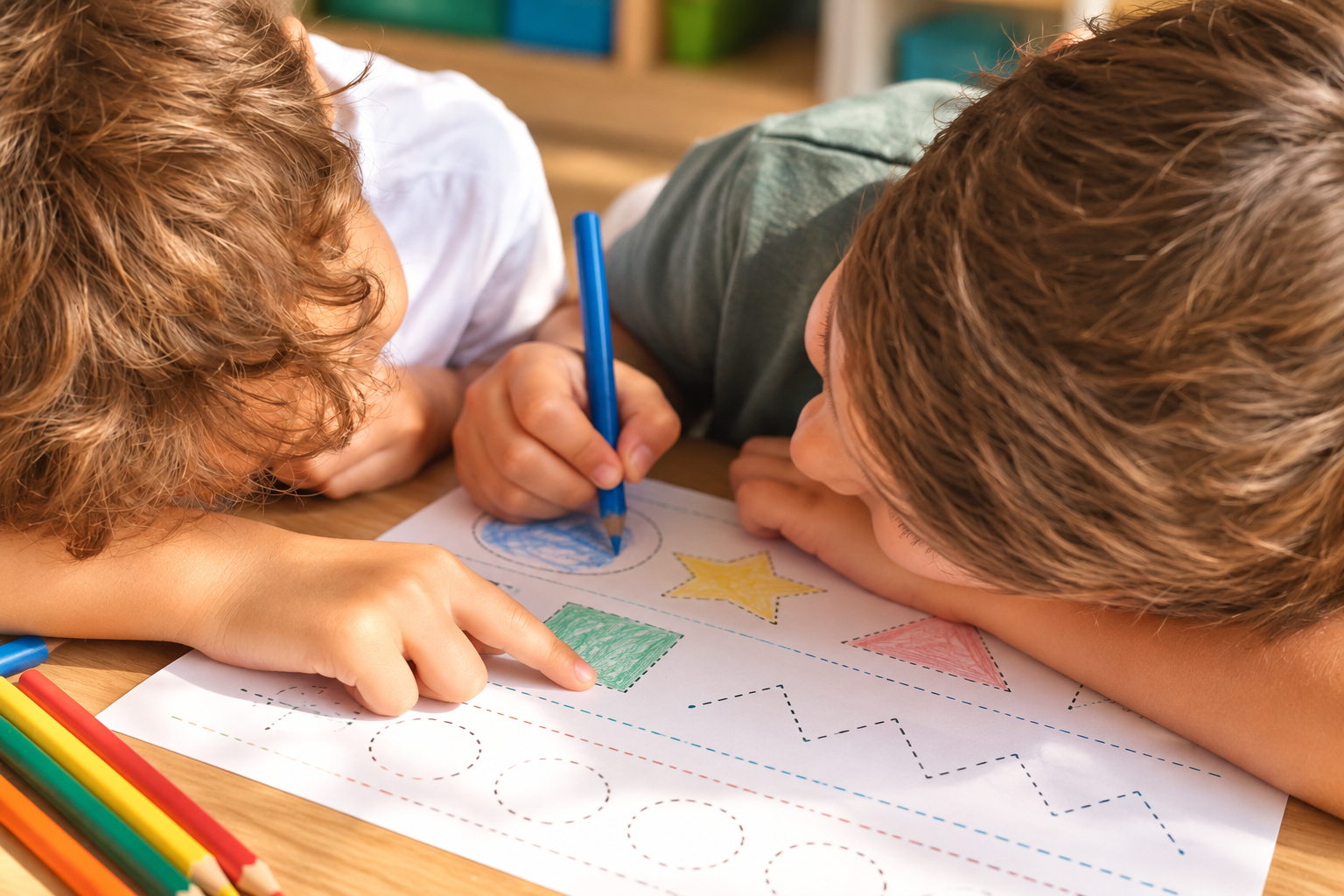
What does European-inspired learning look like?
Less “memorize this.”
More “figure this out.”
Designed to build curiosity, reasoning, independence and real-world understanding through simple, beautiful activities.
Think • Notice • Question • Create • Explore
🇩🇰 DENMARK — Explore the World Around You
Learning doesn’t have to stay at a desk. Nature, movement, everyday experiences and open-ended play encourage children to discover for themselves.
🇪🇪 ESTONIA — Think, Explore + Connect
Children investigate, experiment and make connections instead of learning every skill in isolation. Estonia’s Scandinavian approach explicitly incorporates child-centered active learning, research and outdoor learning.
🇯🇵 JAPAN — Independence + Observation
Slow down. Look closely. Notice the details. Try again. Activities encourage patience, observation, independence and thoughtful problem-solving.
🇨🇭 SWITZERLAND — Hands-On, Everyday Learning
Real objects, practical experiences and meaningful activities help little learners connect new concepts to the world around them.
🇷🇸 SERBIA — Play, Create + Discover Together
Learning grows through play, relationships and shared discovery. Children are encouraged to explore, create, collaborate and investigate ideas that are meaningful to them.
🇫🇮 FINLAND — Learn Through Play
Curiosity comes first. Play, exploration and child-led discovery turn everyday moments into meaningful learning.
We take inspiration from around the world you can bring into your home.
A worksheet isn't the whole lesson. It's the starting point.
Take It Outside: Find three different leaves. Which is biggest? Which has the most points? What is the same about them? What is different?
After a leaf worksheet
After a volcano worksheet
Keep Thinking: Why do you think people choose to live near volcanoes?
After a squirrel activity
Go Explore: Look outside for something an animal could use as food, shelter or nesting material.
Children practice the foundations—letters, numbers, phonics, math and fine motor skills—but they're also encouraged to notice patterns, follow clues, make predictions, solve problems, explain their thinking and explore the world around them.
Because knowing what is important.
Learning to ask why is even better.