
Through a Baby’s Eyes with Dr. Frantz
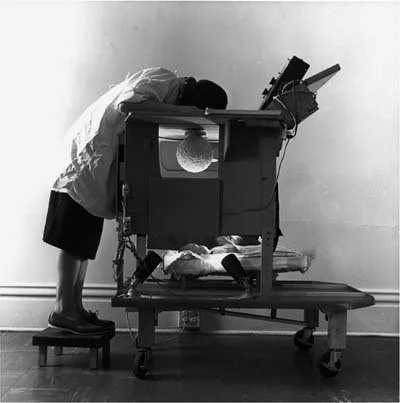
In the 1960s, a clever psychologist named Robert Fantz came up with a fun way to figure out what babies are looking at. He created what he called the “Looking Chamber”. An enduring feature of human nature is if there’s something of interest near us, we generally look at it.
The experiment worked like this: Fantz would show babies 2 different pictures—one plain and boring (think simple patterns like a bulls-eye) and the other more interesting, like a sketch of a human face. Then, sneakily hidden behind the display, Fantz would peek through a little hole to watch what the babies were doing. By observing the reflection in the infants’ eyes, researchers were able to observe and record how long the infant engaged with each display.
So, what did Fantz find? Babies were WAY more into faces than boring patterns. Even as young as 2 months old, these little humans would spend twice as much time staring at the picture of a face. Fascinating, right? This was a huge deal because, until then, people thought babies just saw the world as a big confusing blur. But Fantz showed that from a super young age, babies could perceive and have preferences— especially faces!
This discovery helped change how we understand infant development. It turns out babies aren’t just passive little beings taking in random sights—they’re tiny explorers with some powers of pattern and form selection. Before this, it was thought that babies looked out onto a chaotic world of which they could make little sense. Fantz’s work opened the door to all kinds of research into how babies perceive the world and just how much they know, even before they can talk!
You can read more on the study here.
