
Little Thinkers • Little Lessons
What can we learn today?
Ages 3–5 • 10–15 minutes • Minimal Prep
The Squirrel Lesson
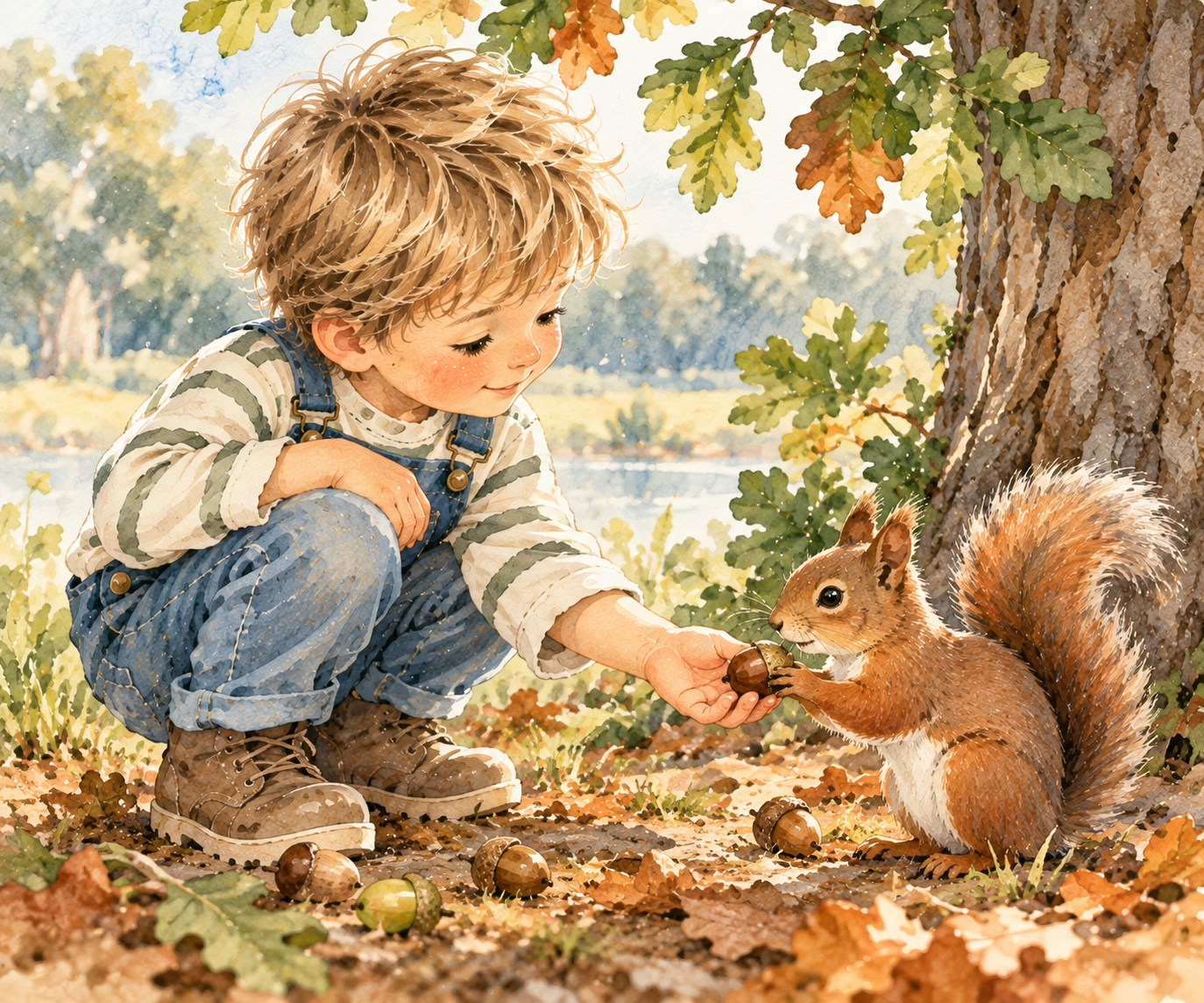
Today we're becoming squirrel scientists!
You’ll need:
A window or outdoor space • 5 small objects • paper + crayons
1. LEARN — Meet the squirrel.
Squirrels are mammals.
They have fur, breathe air and have live babies.
Many squirrels eat foods such as:
🌰 nuts
🌱 seeds
🍓 fruits
🌼 plants
Squirrels also have strong front teeth called incisors that help them gnaw.
Ask:Why do you think a squirrel needs strong teeth?
2. OBSERVE — If you can spot a squirrel outside, stop and watch quietly.
How does it move?
Can you see it...
☐ running
☐ climbing
☐ jumping
☐ digging
☐ eating
☐ using its tail
Now look closely at its body.
What helps a squirrel climb a tree?
Look for its claws, legs and tail.
3. COUNT — Fill the Squirrel's Stash
Pretend 5 small objects are acorns.
Count them: 1 • 2 • 3 • 4 • 5
The squirrel finds 2 more acorns.
How many does it have now? 5 + 2 = ____
Now the squirrel eats one.
How many are left? 7 − 1 = ____
Use the pretend acorns to figure it out.
4. COMPARE — Imagine two squirrels collecting food.
Squirrel A: 🌰🌰🌰
Squirrel B: 🌰🌰🌰🌰🌰
Ask:
Who collected more?
Who collected less?
How many more did Squirrel B collect?
Now make the groups equal.
How many acorns does Squirrel A need?
5. MOVE — Move Like a Squirrel!
Try these challenges:
JUMP over a pretend branch.
CLIMB by pretending to scramble up a tree.
CROUCH down to bury an acorn.
FREEZE when you hear a sound.
Then ask: Why might freezing and listening help a squirrel stay safe?
6. THINK
Squirrels sometimes bury food and return for it later.
Imagine you are a squirrel.
You have an acorn to hide.
Would you hide it...in the middle of a sidewalk or under leaves near a tree?
Why?
Now ask: What could help you remember where you buried it?
Let your child invent a strategy.
LITTLE THINKERS CHALLENGE — Where Did the Squirrel Hide the Acorn?
Place 5 small objects in front of your child.
Pretend one is an acorn.
Have your child study where everything is.
Then: Close your eyes!
Move the “acorn” to a different location.
Open your eyes. What changed?
Make each round harder by moving two objects.
You're practicing visual memory, attention and spatial reasoning.
LITTLE QUESTION OF THE DAY
Why does a squirrel have such a big, fluffy tail?
What does your little thinker think?
A squirrel's tail can help with balance while climbing and jumping. It can also help with communication and provide some protection from weather.
Now try this:
Stand on one foot.
Then stretch your arms outward.
Which way makes balancing easier?
Talk about how different body parts can help animals move.
TAKE IT FURTHER — Go on a Squirrel Detective Walk.
You don't even have to find a squirrel.
Instead, look for evidence that squirrels might live nearby.
Can you find:
🌳 trees
🌰 nuts or seeds
🍂 disturbed leaves
🐾 animal tracks
🕳️ places food could be hidden
🐿️ a squirrel!
Then ask: What makes this a good place for a squirrel to live?
Think about:
FOOD • WATER • SHELTER • SPACE
DID YOU KNOW?
🐿️ Squirrels can help forests grow.
When squirrels bury nuts and seeds, they don't always retrieve every one.
Some forgotten seeds can eventually grow into new plants or trees.
Think about that: A squirrel can plant a tree without even knowing it!
LOVED TODAY’S LITTLE LESSON?
Keep exploring squirrels through maps, memory, counting, patterns, spatial thinking and problem-solving with Little Thinkers Woodland Animal Workbook.